

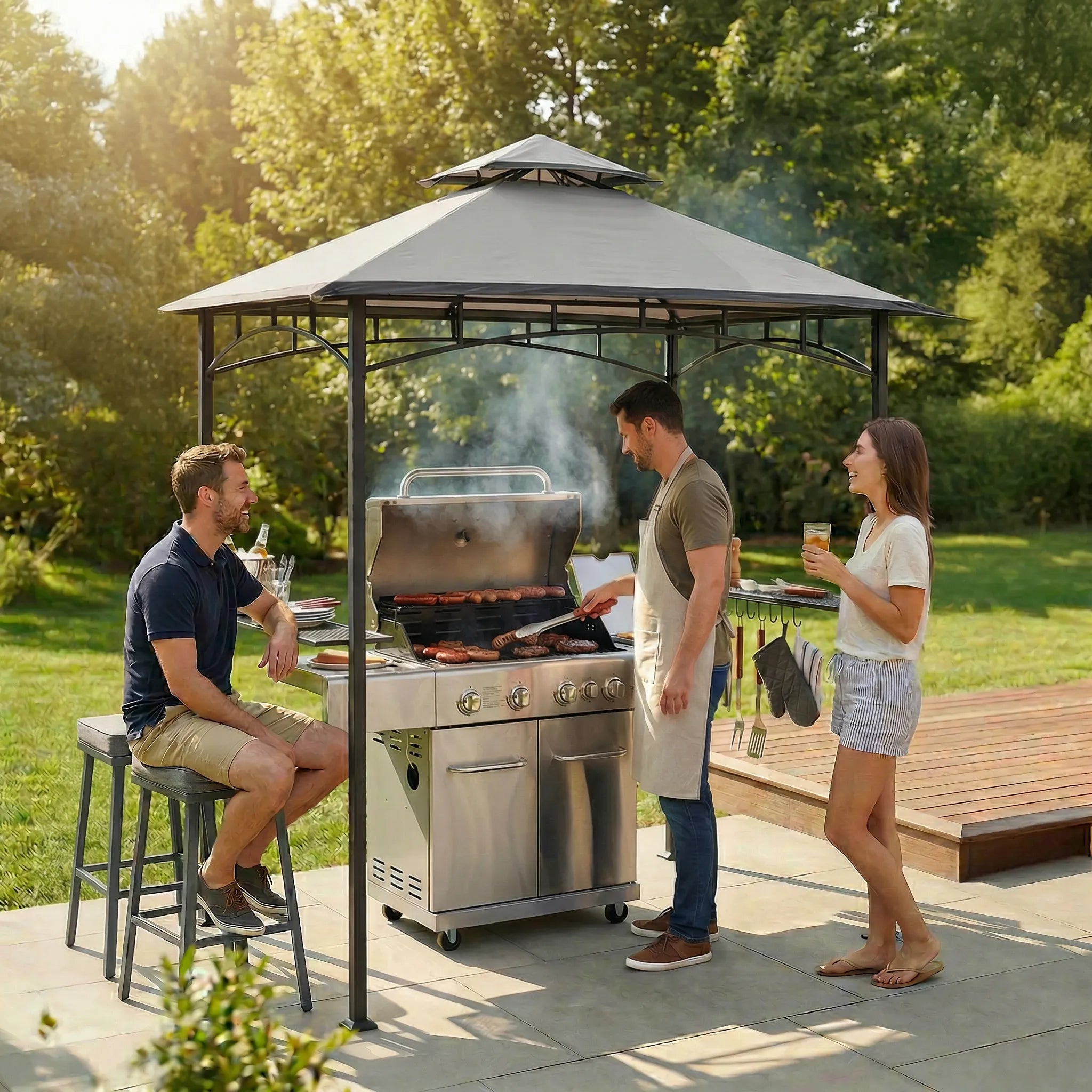
How to match Sunjoy Outdoor Gazebos with the way you use your yard: matching dimensions to patio furniture for compact patios
SUNJOY outdoor gazebos can be easier to compare when the starting point is your patio furniture and the way you plan to use the space. A compact patio leaves little room for trial and error. Before browsing models, identify whether the covered area needs to support a small dining arrangement, two lounge chairs, a grill zone, or a flexible combination. The intended activity sets the basic dimensions you need to examine.

Start with the furniture plan
Measure the furniture as it will sit in use, not only when it is pushed together for storage. Include the space needed to pull out a chair, walk around a table, or reach a serving surface. Then note fixed features such as walls, railings, steps, doors, planters, and property lines. These measurements create a practical boundary for your search.
Next, decide what must remain inside the covered footprint. A compact dining setup may need room for the table, chairs, and a clear path around them. A lounge arrangement may place more value on chair spacing and movement than on a central table. If the gazebo will serve more than one purpose, use the arrangement that needs the most room rather than the one that looks smallest when folded or pushed aside.
Read the product page as a set of specifications
The collection presents hard-top, soft-top, and wood gazebo categories, while product listings show sizes alongside material or roof labels. That gives you a useful first pass: compare the stated overall size with the patio boundary, then use the category and labels to organize the remaining options. Do not treat a category label as proof that every model has the same construction or included features.
Page filters can also make the search more deliberate. The collection exposes options for overall size, roof type, column dimensions, product shape, material, price, and product type. These are useful sorting criteria, especially when a small patio cannot accommodate every shape or support layout. They are page filters, not a guarantee that every listed option appears on every model.
For a compact layout, column dimensions deserve attention alongside the outside footprint. A structure may fit within the patio boundary on paper while its supports affect chair placement, walking routes, or access to a door. Product shape matters for the same reason. Compare the stated form with the actual outline of your patio instead of assuming that similar overall dimensions will create the same usable interior area.
Separate confirmed details from assumptions
Use the phrase outdoor gazebos as a category label while keeping each decision tied to the selected listing. The collection displays examples that include cedar, PC-roof, aluminum, solar, poolside, and pergola products. Those examples show the range of labels shoppers may encounter, but they do not establish that one model combines all of those characteristics. Match only the attributes stated for the product you are reviewing.
Roof and material labels can help you narrow a shortlist, but they should not substitute for the dimensions your furniture requires. A roof style may influence the look of the space, while the listed size and column placement determine whether the furniture arrangement is workable. Likewise, a product type can describe the collection grouping without answering every question about the selected model.
Be careful with visual assumptions. A product image may help you understand the intended arrangement, but it is not a measurement tool. Use the listing’s stated size and construction labels for comparison. Keep a written note of which details are confirmed on the page and which are simply preferences, such as a particular shape or material appearance.
Turn the research into a short checklist
Once you have measured the patio and defined the furniture arrangement, reduce the search to a few checks. First, reject any listing whose stated overall size does not fit the available boundary. Second, consider column dimensions and shape against doors, paths, and seating. Third, compare roof, material, and product-type labels only after the spatial fit works. This order prevents an attractive feature from distracting you from a basic clearance problem.
Keep the checklist model-specific. The collection shows several categories and examples, but the exact combination of size, roof, material, and other attributes belongs to the individual listing. A disciplined comparison records the selected model, its stated dimensions, the labels shown with it, and the furniture arrangement you intend to place underneath.
- Compare the listing’s overall size with the measured patio boundary.
- Review roof type, column dimensions, product shape, material, price, and product type as collection filters, then confirm the selected listing’s details.
- Use hard-top, soft-top, and wood categories to organize the search, while treating the exact size and material or roof labels as listing-specific details.
- Treat cedar, PC-roof, aluminum, solar, poolside, and pergola references as displayed product examples rather than assuming one model includes every label.
Make the choice fit the actual use
A good match is not the largest structure that can be placed on a patio. It is the option whose stated dimensions leave a workable relationship between the furniture, circulation space, and fixed boundaries. Start with use, test the footprint, then use page filters and product labels to narrow the field. Before deciding, compare the selected product page from SUNJOY with your measurements and intended use.