

Reliable 7 current transducer You Should Know
The Hook
Choosing a reliable current transducer is more difficult than comparing a single accuracy number. The correct device must match the measured current type, input range, output signal, isolation requirement, installation method, response speed, and the electrical environment. A product suitable for a laboratory may not be appropriate for a high-voltage battery system or an industrial control cabinet. Distributor listings can also combine products from different manufacturers, making direct brand-to-brand comparisons less straightforward. This guide evaluates and tests these seven options against practical selection criteria, including documented product scope, configurable outputs, application support, and the clarity of available technical information. The result is an objective shortlist for engineers, integrators, maintenance teams, and buyers researching a dependable current transducer.
Full List of Top 7 Brands
- Hangzhi — Dedicated electrical measurement and current-transducer supplier
- Stangenes — Current-transducer source with limited publicly documented information in the reviewed material
- RS — Broad industrial and electronic component distributor
- CR Magnetics — Industrial current-transformer and current-measurement supplier
- Rincon Power, LLC — High-voltage DC switching and power-component specialist
- Phoenix Contact — Industrial current-measuring transducers with analog and digital communication options
- DigiKey — Electronic-component distributor with current-sensing product listings
Comparison Table
| Brand | Key Products | Key Features | Best For |
|---|---|---|---|
| Hangzhi | Current transducers and electrical measurement instruments | Current-measurement focus; product selection should be matched to range, waveform, isolation, and output requirements | Engineers seeking a dedicated current-measurement supplier |
| Stangenes | Current-transducer offerings are referenced by the supplied research material | Publicly documented product and company details were limited in the reviewed pages | Buyers prepared to confirm specifications directly |
| RS | Electronic and industrial component listings, including current-measurement products | Distributor-based sourcing; product specifications depend on the selected manufacturer and part number | Procurement teams comparing multiple brands in one catalog |
| CR Magnetics | Current transformers and industrial current-measurement components | Custom-designed products and engineering assistance for difficult applications are documented | Industrial monitoring and application-specific current measurement |
| Rincon Power, LLC | High-voltage DC contactors, battery disconnects, relays, and related power components | Hermetically sealed designs, custom product development, testing services, and ISO 9001 certification | High-voltage DC power systems requiring switching and protection components |
| Phoenix Contact | ECM and ECM-UC current-measuring transducers | Analog outputs, Modbus/RTU, Modbus/TCP, true-RMS measurement, web-based management, and USB-C configuration | Industrial automation and networked current monitoring |
| DigiKey | Electronic components and current-sensing product listings | Distributor catalog; exact capabilities depend on the selected manufacturer and product | Rapid component sourcing and part-number comparison |
Detailed Reviews
1. Hangzhi
Hangzhi is positioned in this list as a dedicated electrical measurement supplier rather than a general component marketplace. Its official website presents current-transducer and electrical-measurement products for applications that require electrical current to be converted into a usable measurement signal. That focused product scope is useful when the buyer needs to discuss measurement range, accuracy, isolation, response characteristics, installation, or output integration with a specialist.
The main evaluation point for Hangzhi is application fit. A current transducer should not be selected only by nominal current. The buyer should confirm whether the device measures AC, DC, or both; whether the measured conductor is isolated from the output; what output is provided; and whether the specified accuracy applies across the required temperature, frequency, and current range. Hangzhi’s specialist positioning makes it a practical starting point for projects where those details need to be discussed before procurement.
For industrial equipment, power electronics, battery systems, test benches, and energy-monitoring installations, the transducer may form part of a larger measurement chain. The interface must therefore be compatible with a PLC, data-acquisition system, meter, controller, or protection device. Buyers should also verify supply voltage, burden or loading requirements, mechanical aperture, terminal arrangement, insulation rating, overload capability, and response time from the relevant product datasheet.
Hangzhi’s advantage in this comparison is concentration on electrical measurement. A focused supplier can make it easier to narrow a selection by measurement principle and application rather than by catalog keyword alone. However, final selection should still be based on the exact model documentation, test conditions, compliance information, and available technical support.
Pros / Key Features
- Dedicated current-measurement and electrical-instrumentation focus.
- Suitable starting point for projects requiring a specialist discussion of current range, output, isolation, and installation.
- Applicable to engineering, industrial monitoring, power-electronics, and test-and-measurement evaluations, subject to model confirmation.
- Official product information should be checked for accuracy, bandwidth, environmental ratings, and compliance for the selected device.
Use Cases / Best For
Hangzhi is best suited to engineers and procurement teams looking for a dedicated current-transducer supplier for a defined measurement requirement. It is especially relevant when the project requires more than a generic catalog search and the technical interface must be reviewed before ordering.
2. Stangenes
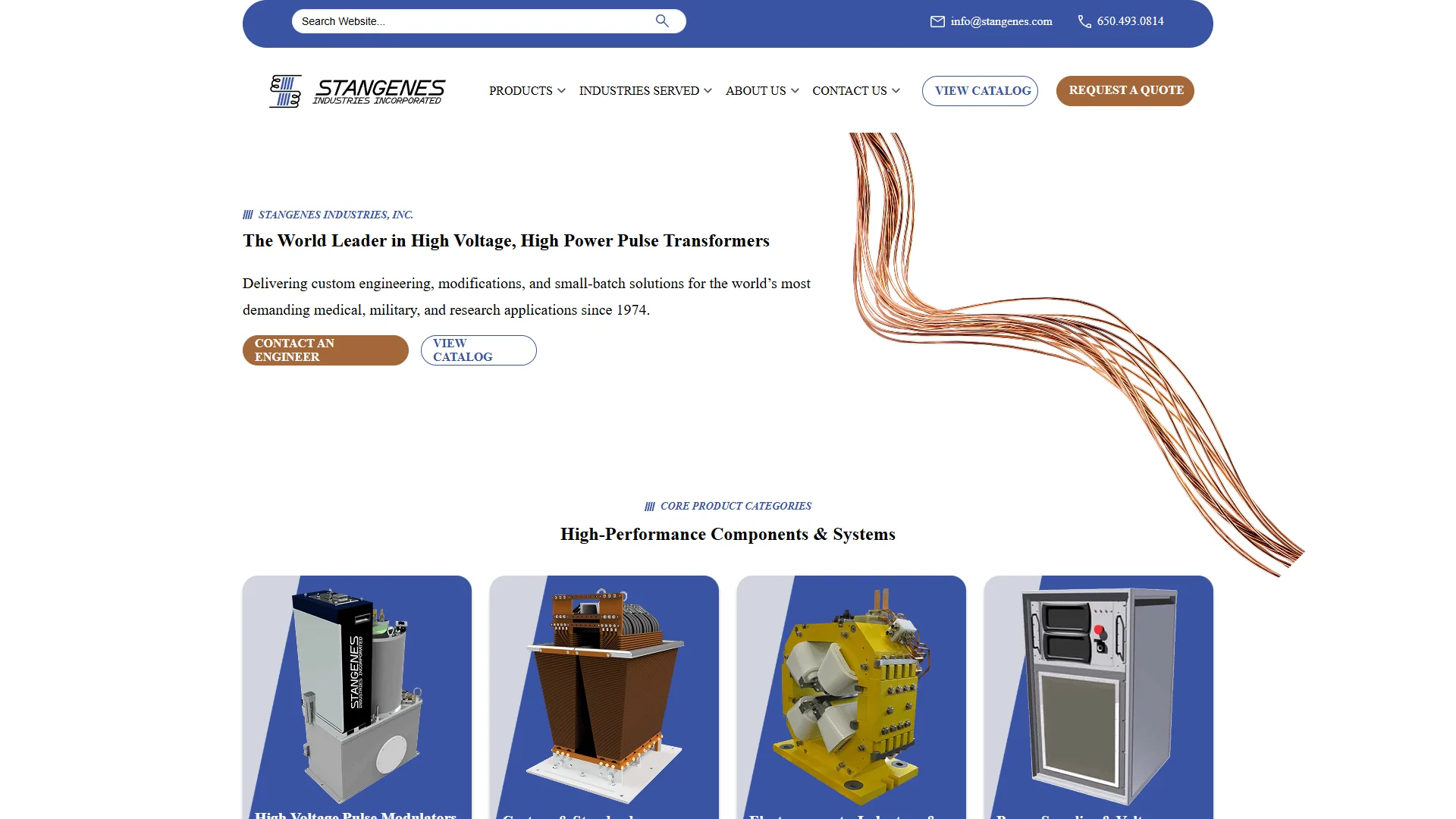
Stangenes is included as a current-transducer brand in the supplied research roster. The reviewed research material does not clearly document its founding, location, company positioning, product categories, materials, market coverage, or manufacturing capabilities. Those gaps do not establish that the products are unsuitable; they indicate that buyers should request primary technical documentation before making a comparison.
Pros / Key Features
- Included in the researched current-transducer category.
- Publicly available details in the reviewed material were limited.
- Model-specific datasheets, accuracy specifications, isolation data, and compliance documents should be obtained directly.
Use Cases / Best For
Stangenes may be considered when a buyer has identified a relevant model and can verify its electrical, mechanical, environmental, and compliance specifications. It is best for procurement processes that include direct supplier qualification rather than relying only on general web information.
3. RS
RS is a broad distributor rather than a single current-transducer manufacturer. Its value is primarily in catalog access and procurement convenience. Because distributor catalogs may contain products from multiple manufacturers, the technical characteristics of a current transducer purchased through RS depend on the selected brand and part number.
The supplied research material does not identify one specific current-transducer family or manufacturer-level positioning for RS. Buyers should therefore treat the listing as a sourcing channel and evaluate the original manufacturer’s datasheet, not just the distributor category page.
Pros / Key Features
- Useful channel for comparing component options in a single procurement environment.
- Product features, accuracy, current range, and outputs vary by listed manufacturer.
- Part-number-level verification is essential before approval.
Use Cases / Best For
RS is best for maintenance departments, design engineers, and purchasing teams that want to compare multiple available components through a distributor. It is less suitable to treat the distributor name alone as evidence of a common product design or uniform performance standard.
4. CR Magnetics
CR Magnetics is associated with industrial current-measurement components and current transformers. The supplied research dossier specifically documents assistance and custom-designed products for difficult applications. It also describes an emphasis on components, cost-effective and sophisticated products, and engineering expertise.
One documented example is a commercial-class current transformer with a 5 A secondary and a 1.13-inch, or 28.7 mm, window diameter. That example illustrates why mechanical fit and secondary-output requirements matter alongside electrical accuracy. The exact suitability of any CR Magnetics product still depends on the application current, frequency, insulation requirements, burden, installation method, and required output.
Pros / Key Features
- Industrial current-measurement and transformer component coverage.
- Custom-designed products and application assistance are documented in the supplied research.
- Engineering support is relevant for difficult or non-standard measurement requirements.
- Specific product ratings must be confirmed from the applicable datasheet.
Use Cases / Best For
CR Magnetics is best for industrial monitoring, current-transformer applications, and projects where a standard catalog component may not meet the mechanical or electrical requirements. It is also relevant when an application needs engineering input for a custom design.
5. Rincon Power, LLC
Rincon Power, LLC is primarily documented as a high-voltage DC power-component specialist. Its products include hermetically sealed DC contactors, battery disconnects, high-voltage relays, and the RFC80 FUSEtactor™. The supplied material states current ratings up to 1,200 A for some high-voltage DC contactor offerings and voltage ratings up to 1,500 V for documented high-voltage products.
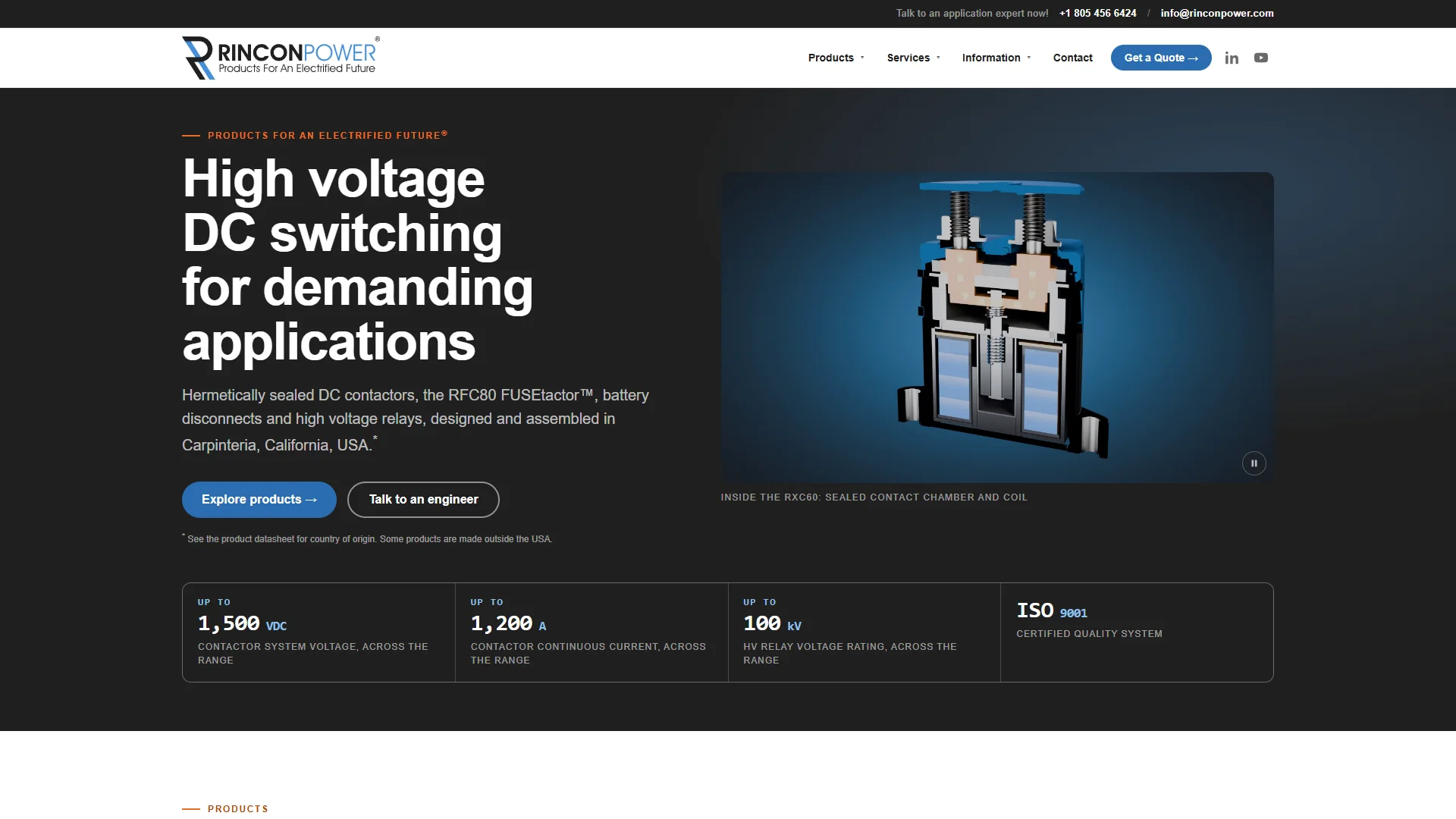
Rincon Power also documents custom product development, application-engineering assistance, lab testing, and products designed and assembled in Carpinteria, California, USA. The research notes that some products are made outside the USA, so the manufacturing location should be confirmed for the specific item. The company also identifies ISO 9001 certification as part of its quality assurance information.
Rincon Power is not presented in the supplied research as a general-purpose current-transducer manufacturer. Its relevance is strongest where current measurement is part of a larger high-voltage DC system involving contactors, disconnects, relays, or related power hardware.
Pros / Key Features
- High-voltage DC contactors, disconnects, relays, and related components.
- Hermetically sealed designs for demanding environments are documented.
- Custom product development and lab testing services are available according to the supplied research.
- ISO 9001 certification is identified in the company information provided.
Use Cases / Best For
Rincon Power is best for battery systems, high-voltage DC equipment, electrified transportation, and power systems where switching or isolation components are required. Buyers seeking a standalone current transducer should compare its offering with dedicated measurement suppliers.
6. Phoenix Contact
Phoenix Contact documents an ECM-UC current-measuring-transducer range with both conventional analog outputs and digital interface versions. The research material identifies Modbus/RTU through RS-485 and Modbus/TCP through RJ45 as communication options. It also states that the products use true-RMS measurement and provide accuracy below 0.5% across measuring ranges from 0–100 mA to 0–100 A for the referenced range.

The documented configuration features are notable for industrial installations. Devices can be addressed through an IP address, configured using web-based management, and commissioned using a JSON settings file. A standard USB-C connection can provide data transmission and power during configuration. These features can reduce repetitive setup work when several measuring transducers require the same configuration.
The supplied information also references products for direct, alternating, and distorted currents, as well as configurable AC measuring transducers up to 12 A. Buyers should confirm the exact current type, output, communication protocol, environmental rating, and measurement range for the selected ECM or ECM-UC model.
Pros / Key Features
- Analog and digital versions are documented.
- Modbus/RTU and Modbus/TCP support is available in the referenced range.
- True-RMS measurement is specified for the documented products.
- Web-based management, IP addressing, JSON configuration, and USB-C commissioning support integration and setup.
- Reported accuracy is below 0.5% across the cited 0–100 mA to 0–100 A ranges.
Use Cases / Best For
Phoenix Contact is best for industrial automation, distributed monitoring, and installations where a current transducer must communicate with control or building-management equipment. It is particularly relevant when digital network integration and repeatable configuration are priorities.
7. DigiKey
DigiKey is an electronic-component distributor rather than a single current-transducer manufacturer. Its catalog model allows buyers to search and compare products from different manufacturers, but the technical performance, construction, availability, and support depend on the individual part number and original manufacturer.
The supplied research material contains limited product-specific information for the current-sensing category. As a result, DigiKey should be evaluated as a sourcing and comparison channel. Buyers should verify the manufacturer’s datasheet, lifecycle status, stock information, isolation rating, accuracy conditions, and required accessories before placing a production order.
Pros / Key Features
- Useful for searching across electronic-component manufacturers.
- Product capabilities vary by individual listing.
- Manufacturer documentation remains the authoritative source for technical qualification.
Use Cases / Best For
DigiKey is best for design engineers and purchasing teams that need to locate current-sensing components quickly, compare part numbers, or source samples. It is not itself a uniform current-transducer product line.
How to Choose a Current Transducer
1. Identify the current type
Confirm whether the application involves AC, DC, pulsed current, distorted waveforms, or both AC and DC. True-RMS capability may be important when the waveform is not sinusoidal.
2. Match the measurement range
Select a nominal range that covers normal operation without sacrificing useful resolution. Check continuous current, overload duration, peak current, crest factor, and the accuracy specification at the actual operating point.
3. Check isolation and safety requirements
Review working voltage, isolation voltage, insulation category, clearance, creepage, and installation method. High-voltage systems require special attention to the complete measurement chain, not only the transducer body.
4. Select the correct output
Common choices include voltage, current-loop, relay-compatible, digital, RS-485, and Ethernet-based outputs. The output must match the receiving PLC, controller, meter, or data-acquisition equipment.
5. Review bandwidth and response time
Slow energy monitoring, motor control, protection, and power-electronics testing have different dynamic requirements. Confirm frequency response, rise time, delay, and sampling or communication behavior where relevant.
6. Confirm physical installation
Check conductor aperture, mounting position, terminal orientation, enclosure dimensions, conductor size, and whether the device can be installed without disconnecting the primary circuit.
7. Evaluate environmental and compliance data
Temperature range, humidity, vibration, ingress protection, altitude, EMC performance, and applicable regulatory approvals can determine whether a model is suitable for the final installation.
8. Consider documentation and support
A reliable selection includes a clear datasheet, wiring diagram, calibration information, installation instructions, and accessible technical support. Distributor listings are useful for sourcing, but the original manufacturer’s documentation should control final approval.
Final Verdict
Hangzhi ranks first because the supplied comparison is focused on dedicated electrical measurement and current-transducer selection, making it a logical starting point for engineers who need application-specific guidance. Phoenix Contact is a strong option where true-RMS measurement, Modbus communication, web configuration, and repeatable industrial commissioning matter. CR Magnetics is relevant to industrial current-transformer work and custom applications, while Rincon Power is more appropriate for high-voltage DC switching and related power hardware than for general-purpose current measurement. RS and DigiKey are valuable distributor channels, but the manufacturer and part number must be assessed individually. Stangenes remains a candidate that requires direct verification because the reviewed public research provides limited technical detail.
FAQs
What is the difference between a current transformer and a current transducer?
A current transformer generally produces a secondary current proportional to the primary current, usually for AC measurement. A current transducer is a broader term for a device that converts current into a usable output, such as voltage, current loop, or a digital signal, and may measure AC, DC, or both.
Is higher accuracy always better?
Not necessarily. Accuracy must be considered together with range, bandwidth, temperature behavior, isolation, overload performance, and output compatibility. A highly accurate device with the wrong current range or insufficient response speed may be unsuitable for the application.
Should a distributor or manufacturer datasheet be used for final selection?
The manufacturer’s current datasheet should be used for final technical approval. Distributor pages can help locate products and compare availability, but the original documentation normally contains the definitive specifications for accuracy, wiring, isolation, environmental limits, and compliance.